All students must study English, Mathematics, Science, Core Physical Education and Personal Development.
Students will then choose four option subjects:
- One from the EBacc block
- One from the Breadth block
- Two from the Open block
In addition, we ask that students choose three reserve subjects: one from the EBacc block and two from the Open block. These may be used in the event that a subject is oversubscribed, so it is important that these are subjects that the student would be happy to study.
Please note, students cannot choose the same subject twice. Students also cannot choose the following combinations of subjects:
- Design Technology & Engineering
- Design Technology Textiles & Design Technology Timbers
- Physical Education (PE) & Sport Studies
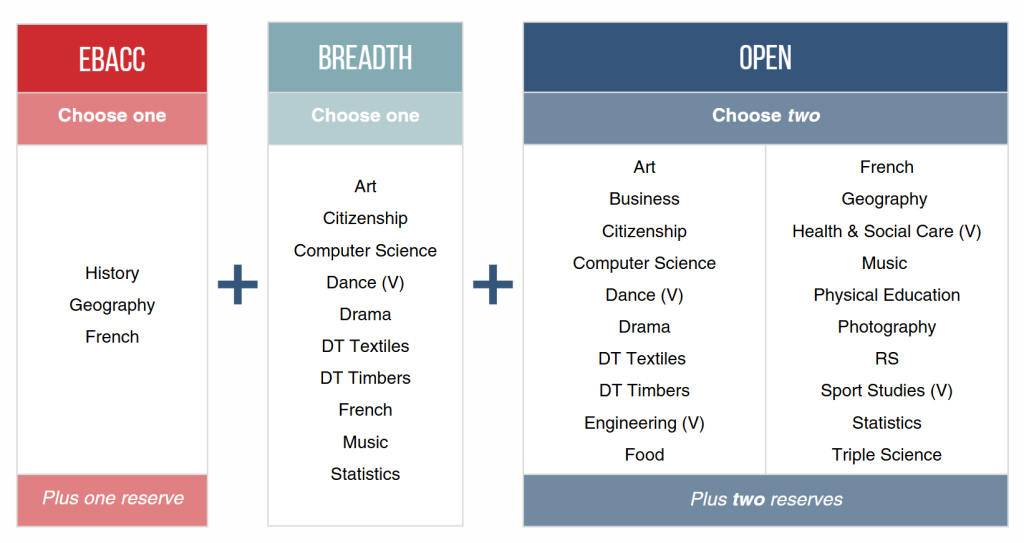
You can download the Year 9 Options Routes table here. (PDF)
Click here to download our guide to ‘Choosing KS4 Options 2026’. (PDF)
Click here to see more information on the curriculum at The Radclyffe School.
Click here to find the exam board specifications of the qualifications that we offer at KS4.
A Broad and Balanced Curriculum
At The Radclyffe School, we are committed to ensuring all students experience a broad and balanced curriculum. This is supported by the government’s curriculum review and its aim to “grasp the opportunity to ensure that more young people are able to choose qualifications that inspire them, reflect their strengths and support the directions they wish to take.”¹
This is further supported by research from the Sutton Trust, which highlights that “attainment is the biggest driver of gaps in university progression”, with important implications for young people’s careers and opportunities for social mobility.² For this reason, they emphasise the importance of providing young people with access to “a modern and broad curriculum”. We have reviewed the way our option subjects are structured in order to offer students a wide range of subjects with as few restrictions as possible.
EBacc Block – We continue to encourage as many students as possible to study an EBacc subject through our EBacc block. Research from the Sutton Trust suggests that studying EBacc subjects can help improve a young person’s performance in English and Maths.
Breadth Block – Through our Breadth block, we are enabling wider access to creative and practical subjects. Research highlights that studying creative subjects is not only important for those interested in the creative industries, but also brings “numerous wider benefits, including improved engagement and wellbeing”.² Creative subjects also provide valuable opportunities for students to develop wider life skills such as confidence, motivation, resilience and communication.
Open Block – Finally, through the Open block, students have free choice from almost the full range of subjects on offer, allowing them to create combinations that reflect their interests, strengths and future ambitions.
We believe students work hardest and achieve most highly in subjects they enjoy, and our options structure is designed to support them in making the right choices for their GCSE studies.
GCSE Courses
GCSEs are at the core of the Key Stage 4 curriculum in England and Wales. They are now linear qualifications, meaning exams take place at the end of Year 11, with limited coursework in most subjects. GCSEs are graded on a 9–1 scale, with 9 being the highest grade. The content and expectations of GCSE courses are now more demanding than in the past. However, the overall distribution of grades has not changed. For example, the proportion of students who previously achieved grades A/A* is now roughly equivalent to those achieving grades 7–9, while a grade 4 today broadly compares to the old grade C.
Achieving a grade 4 is an important benchmark and is often the minimum requirement for entry to many post-16 courses. However, many colleges and sixth forms look for a grade 5 (a ‘strong pass’). While a grade 4 may allow entry onto some courses, these are often Level 2 courses (equivalent to GCSE level).
Many Level 3 courses require grade 5s or above, and students who do not achieve these grades may need to resit GCSEs in order to progress further. For this reason, students should aim to achieve at least grade 5s in as many subjects as possible, and higher where they are able.
While GCSE results help students move on to the next stage of education, they also remain important for future applications to college, apprenticeships, jobs and university. A strong set of GCSE results can help students stand out from other applicants. This is why choosing the right options is so important. Students should aim to select subjects they enjoy and feel motivated by, as well as subjects where they are already performing well, so that they can work hard and achieve the best possible results.
Vocational Qualifications
These are an essential part of The Radclyffe School’s curriculum. As part of the changes to the KS4 exam system, there have been changes to the scope and range of vocational qualifications to ensure that they are as challenging and rigorous as GCSEs, and that they provide students with the skills and knowledge they need for further progression.
We offer three types of vocational qualifications at The Radclyffe School:
- Pearson BTEC
- OCR Cambridge National/OCR Cambridge Technical
- NCFE Technical Award
The key difference with vocational subjects is that a greater proportion of the assessment is through coursework: the student’s written and/or practical work forms a portfolio that will then be graded. This can help students organise their workload throughout Years 10 and 11 rather than being assessed only at the end of the course. However, it does mean that students have to meet specific deadlines throughout both Year 10 and 11 to submit their assignments. It also means that many of these courses, alongside a more practical element, do also have elements that expect a significant amount of extended written response.
Students achieve excellent results on vocational courses. All vocational courses are offered as a Level 2 qualification (this means that they are equivalent to a GCSE grade 4-9).
The grades awarded will be:
- Level 2 Distinction* = 8/9 (For BTEC and OCR Nationals)
- Level 2 Distinction = 7
- Level 2 Merit = 6
- Level 2 Pass = 4/5
The Level 1 vocational qualification is equivalent to a GCSE at grade 1-3. The grades at Level 1 are as follows:
- Level 1 Distinction = 3
- Level 1 Merit = 2
- Level 1 Pass = 1
All vocational courses offered form a firm foundation for progression to college and work. Employers and colleges are familiar with the benefits of vocational awards and they show that students are capable of organising their own workload.
Both Oldham College and Oldham Sixth Form College offer a range of vocational qualifications at Levels 2 and 3. In the case of BTEC, this allows students to continue studying their subjects when they leave school. Studying a BTEC qualification at school will therefore allow students to become familiar with the college assessment process.
Universities accept BTEC Level 3 as an entry requirement for a number of degree level courses.


